
前言
字符串是存储在内存的连续字节中的一系列字符。C++ 处理字符串的方式有两种,一种来自 C 语言,常被称为 C-风格字符串,另一种是基于 string 类库的字符串处理方式。C 风格字符串的处理可以参考 https://www.cnblogs.com/tongye/p/10688941.html ,本文着重介绍 string 类库的使用。
string 类简介
C++ 中提供了专门的头文件 string(注意不是 string.h,这个是 C 风格字符串相关函数的头文件),来支持 string 类型。string 类定义隐藏了字符串的数组性质,让我们可以像处理普通变量那样处理字符串。string 对象和字符数组之间的主要区别是:可以将 string 对象声明为简单变量,而不是数组。
string 类几种常见的构造函数
1)string(const char *s) :将 string 对象初始化为 s 指向的字符串1
string str("Hello!");
2)string(size_type n,char c) :创建一个包含 n 个元素的 string 对象,其中每个元素都被初始化为字符 c1
string str(10,'a');
3)string(const string &str) :将一个 string 对象初始化为 string 对象 str(复制构造函数)1
2string str1("hello!");
string str2(str1);
4)string() :创建一个默认的 string 对象,长度为 0(默认构造函数)1
string str; // 创建一个空的 string 对象
string 类的设计允许程序自动处理 string 的大小,因此,上述代码创建了一个长度为 0 的string 对象,但是向 str 中写入数据时,程序会自动调整 str 的长度。因此,与使用数组相比,使用 string 对象更方便,也更安全。
用 C 语言风格初始化 string 对象
C++ 允许使用 C 语言风格来初始化 string 对象:
1
string str = "hello!";
获取 string 对象的长度
在 C 语言中,使用 strlen 函数获取字符串的长度。在 C++ 中,可以使用 string.size() 函数或 string.length() 函数来获得 string 对象的长度。在 C++ 标准库中,两者的源代码如下:1
2
3
4
5
6
7
8
9size_type __CLR_OR_THIS_CALL length() const
{ // return length of sequence
return (_Mysize);
}
size_type __CLR_OR_THIS_CALL size() const
{ // return length of sequence
return (_Mysize);
}
可见,这两个方法是完全一样的,并没有区别。length() 方法是 C 语言习惯保留的,size() 方法则是为了兼容 STL 容器而引入的。1
2
3string str("Hello,World!");
int strLen1 = str.length();
int strLen2 = str.size();
复制 string 对象
在 C 语言中,使用 strcpy、strncpy 函数来实现字符串的复制。在 C++ 中则方便很多,可以直接将一个 string 对象赋值给另一个 string 对象,即:1
2
3string str1("Hello,World!");
string str2;
str2 = str1;
由于 string 类会自动调整对象的大小,因此不需要担心目标数组不够大的问题。
string 对象的拼接和附加
在 C 语言中,使用 strcat、strncat 函数来进行字符串拼接操作。在 C++ 中也有多种方法来实现字符串拼接和附加操作:
使用 + 操作符拼接两个字符串
1 | string str1("hello "); |
使用 += 操作符在字符串后面附加内容
1 | string str1("hello "); |
使用 string.append() 函数
1 | string str1 = "hello,world!"; |
使用 string.push_back() 函数
1 | string str("Hello"); |
string 对象的比较
在 C 语言中,使用 strcmp、strncmp 函数来进行字符串的比较。在 C++ 中,由于将 string 对象声明为了简单变量,故而对字符串的比较操作十分简单了,直接使用关系运算符(==、!=、<、<=、>、>=)即可:1
2
3
4
5
6
7
8
9
10
11
12
13
14
15
16
17
using namespace std;
int main()
{
string str1("hello");
string str2("hello");
if(str1 == str2)
cout << "str1 = str2" << endl;
else if(str1 < str2)
cout << "str1 < str2" << endl;
else
cout << "str1 > str2" << endl;
return 0;
}
当然,也可以使用类似 strcmp 的函数来进行 string 对象的比较,string 类提供的是 string.compare() 方法,函数原型如下:1
2
3
4
5
6int compare(const string&str) const;
int compare(size_t pos,size_t len,const string&str) const; // 参数 pos 为比较字符串中第一个字符的位置,len 为比较字符串的长度
int compare(size_t pos,size_t len,const string&str, size_t subpos,size_t sublen) const;
int compare(const char * s) const;
int compare(size_t pos,size_t len,const char * s) const;
int compare(size_t pos,size_t len,const char * s,size_t n) const;
compare 方法的返回值如下:
1)返回 0,表示相等;
2)返回结果小于 0,表示比较字符串中第一个不匹配的字符比源字符串小,或者所有字符都匹配但是比较字符串比源字符串短;
3)返回结果大于 0,表示比较字符串中第一个不匹配的字符比源字符串大,或者所有字符都匹配但是比较字符串比源字符串长。
使用 string.substr() 函数来获取子串
可以使用 string.substr() 函数来获取子串,string.substr() 函数的定义如下:1
string substr(size_t pos = 0,size_t len = npos) const;
其中,pos 是子字符串的起始位置(索引,第一个字符的索引为 0),len 是子串的长度。这个函数的功能是:复制一个 string 对象中从 pos 处开始的 len 个字符到 string 对象 substr 中去,并返回 substr。1
2
3string str("Hello,World!");
string subStr = str.substr(3,5);
cout << subStr << endl;
这段代码的输出结果为:”lo,Wo”。
访问 string 字符串的元素
可以像 C 语言中一样,将 string 对象当做一个数组,然后使用数组下标的方式来访问字符串中的元素;也可以使用 string.at(index) 的方式来访问元素(索引号从 0 开始):1
2
3string str("Hello,World!");
cout << str[1] << endl; // 使用数组下标的方式访问 string 字符串的元素
cout << str.at(1) << endl; // 使用 at 索引访问 string 字符串的元素
string 对象的查找操作
使用 string.find() 方法查找字符
find 方法的函数原型如下:
1)从字符串的 pos 位置开始(若不指定 pos 的值,则默认从索引 0 处开始),查找子字符串 str。如果找到,则返回该子字符串首次出现时其首字符的索引;否则,返回 string::npos:1
size_type find (const string& str, size_type pos = 0) const;
2)从字符串的 pos 位置开始(若不指定 pos 的值,则默认从索引 0 处开始),查找子字符串 s。如果找到,则返回该子字符串首次出现时其首字符的索引;否则,返回 string::npos: 1
size_type find (const char *s, size_type pos = 0) const;
3)从字符串的 pos 位置开始(若不指定 pos 的值,则默认从索引 0 处开始),查找 s 的前 n 个字符组成的子字符串。如果找到,则返回该子字符串首次出现时其首字符的索引;否则,返回 string::npos:1
size_type find (const char *s, size_type pos, size_type n);
4)从字符串的 pos 位置开始(若不指定 pos 的值,则默认从索引 0 处开始),查找字符 ch 。如果找到,则返回该字符首次出现的位置;否则,返回 string::npos:1
size_type find (char ch, size_type pos = 0) const;
举个查找子字符串的例子(查找字符的代码与这一样,只需要将 find 函数的参数换成字符即可):1
2
3
4
5
6
7
8
9
10
11
12
13
14
15
16
17
18
19
20
21
22
23
using namespace std;
int main()
{
string str("cat,dog,cat,pig,little cat,hotdog,little pig,angry dog");
size_t catPos = str.find("cat",0);
if(catPos == string::npos)
{
printf("没有找到字符串\n");
return 0;
}
while(catPos != string::npos)
{
cout << "在索引 " << catPos << " 处找到字符串" << endl;
catPos = str.find("cat", catPos + 1);
}
return 0;
}
程序输出结果如下: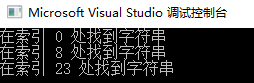
string.rfind()
string.rfind() 与 string.find() 方法类似,只是查找顺序不一样, string.rfind() 是从指定位置 pos (默认为字符串末尾)开始向前查找,直到字符串的首部,并返回第一次查找到匹配项时匹配项首字符的索引。换句话说,就是查找子字符串或字符最后一次出现的位置。还是以上面的程序为例,稍作修改:1
2
3
4
5
6
7
8
9
10
11
12
13
14
15
16
17
18
19
20
21
22
23
24
25
26
27
28
using namespace std;
int main()
{
string str("cat,dog,cat,pig,little cat,hotdog,little pig,angry dog");
size_t catPos = str.rfind("cat",str.length()-1);
if(catPos == string::npos)
{
printf("没有找到字符串\n");
return 0;
}
while(catPos != string::npos)
{
cout << "在索引 " << catPos << " 处找到字符串" << endl;
catPos = str.rfind("cat", catPos - 1);
if(catPos == 0)
{
cout << "在索引 " << catPos << " 处找到字符串" << endl;
break;
}
}
return 0;
}
程序输出结果如下: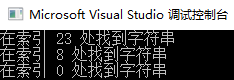
可以看到,rfind 方法是从字符串末开始查找的。
string.find_first_of()
string.find_first_of() 方法在字符串中从指定位置开始向后(默认为索引 0 处)查找参数中任何一个字符首次出现的位置。举个例子说明:1
2
3
4
5
6
7
8
9
10
11
12
13
14
15
16
17
18
19
20
using namespace std;
int main()
{
string str("cat,dog,cat,pig,little cat,hotdog,little pig,angry dog");
size_t pos = str.find_first_of("zywfgat");
if(pos == string::npos)
{
printf("没有匹配到\n");
return 0;
}
else
cout << "在索引 " << pos << " 处匹配到" << endl;
return 0;
}
程序输出结果是:在索引 1 处匹配到。所查找的字符串 zywfgat 中,第一次出现在字符串 str 中的字符是 ‘a’,该字符在 str 中的索引是 1.
string.find_last_of()
string.find_last_of() 方法在字符串中查找参数中任何一个字符最后一次出现的位置(也就是从指定位置开始往前查找,第一个出现的位置)。
string.find_first_not_of()
string.find_first_not_of() 方法在字符串中查找第一个不包含在参数中的字符。
string.find_last_not_of()
string.find_last_not_of() 方法在字符串中查找最后一个不包含在参数中的字符(从指定位置开始往前查找,第一个不包含在参数中的字符)。
string 对象的插入和删除操作
使用 string.insert() 进行插入操作
1 | string&insert(size_t pos,const string&str); // 在位置 pos 处插入字符串 str |
举个例子:1
2
3
4
5
6
7
8
9
10
11
12
13
14
15
using namespace std;
int main()
{
string str("abcdefgh");
str.insert(1,"INSERT"); // 在位置 1 处插入字符串 "INSERT"
cout << str << endl;
str.insert(10, 5, 'A'); // 在位置 10 处插入 5 个字符 'A'
cout << str << endl;
return 0;
}
输出结果如下: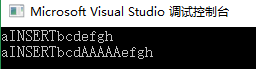
使用 string.erase() 进行元素删除操作
1 | string& erase(size_t pos = 0, size_t len = npos); // 删除从 pos 处开始的 n 个字符 |
举个例子:1
2
3
4
5
6
7
8
9
10
11
12
using namespace std;
int main()
{
string str("Hello,World!");
str.erase(5,6); // 删除从索引位置 5 开始的 6 个字符
cout << "str 为:" << str << endl;
return 0;
}
关于 erase() 函数的用法可以参考 https://www.cnblogs.com/liyazhou/archive/2010/02/07/1665421.html
string 对象的一些其他操作
使用 getline() 函数来获取 string 输入
1 | string str; |
使用 empty() 函数判断字符串是否为空
1 | string str; |
string.empty() 函数,若字符串为空,则返回真,否则返回假。
使用 swap 函数交换两个字符串
1 |
|